

Quick SummaryHair porosity determines its ability to absorb and retain moisture and care products. Understanding your profile helps you adopt a suitable routine, protect your hair against breakage and frizz, and achieve more hydrated, shiny, and resilient hair. In this article, discover porosity, reliable tests, ideal routines, and factors that alter it. |
1. What is hair porosity?
With a consistent hair care routine, it is entirely possible to have healthy curly, wavy, or textured hair.
The key: understanding how your hair fiber interacts with water and care products—what it absorbs well, what it retains, and what to avoid.
Hair is more complex than it seems. Composed mainly of keratin, it is characterized by several parameters: texture (wavy, curly or coily), shaft diameter, follicle size, and above all, porosity.
It is this latter that determines the level of protection your hair needs, its ability to retain moisture and care products, and its drying time.
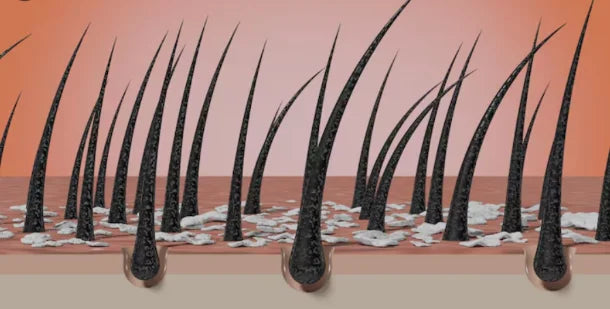
This mechanism is regulated by the cuticle—the outer layer of the hair fiber, which functions like a gate: depending on whether it is open or closed, water and products penetrate more or less easily.
2. What causes hair porosity?

Hair porosity is primarily determined by genetics and hair practices.
Porosity can vary in different parts of the head and even on different lengths depending on hair care routine techniques that could alter and damage the hair cuticle.
A damaged hair cuticle is chipped or torn, exposing the hair cortex of the inner layer of the hair to damage and dryness.
Those with textured hair, particularly curly, wavy, or coily hair, will naturally be subject to more wear and tear.
Sebum (the hair’s natural oil) takes a while to travel down hair strands to lubricate and coat the hair strands, making curly, wavy, and coily hair more prone to damage. This leads to an increase in hair becoming porous.
3. How to test your hair porosity at home
To avoid: the water glass test (float test)
It is commonly used to treat hair porosity, but it is inaccurate. Relying on the water glass test to detect porous hair has been shown to give false readings. This is due to the surface tension of water—water molecules stick together where air should meet water.
Placing lightweight objects like a single hair strand will be like skin on water and will float gently. Therefore, surface tension will counteract the weight and porous hair.
Moreover, dry hair is buoyant in water, so hair and water have similar densities.
The most accurate way to test hair porosity

- Gas Absorption – Gas absorption determines the total pore volume, which corresponds to the holes in the surface. It measures the amount of a given gas that can be absorbed by hair that is more porous and will absorb more gas.
- Hydration Test/Spray Test – This is a qualitative evaluation based on the behavior test where porous hair absorbs water much faster than non-porous hair. This is tested using clean, dry hair. High porosity hair should absorb water faster than low porosity hair, which would instead have visible water beads and a longer drying time.
- Dynamic Vapor Sorption (DVS) – Moisture has a significant impact on hair weight with qualitative records showing an increase and decrease.
- Fiber Swelling – The dimensions of the hair fiber diameter can change and be measured when exposed to water.
- Microscopic Test – It is performed with a microscope that allows you to visually detect the hair cuticle and determine if it is damaged or not. Under the microscope, you can see:
- Low Porosity – Hair cuticles will appear flat and closed.
- Medium Hair Porosity – Hair cuticles are slightly open.
- High Porosity – Hair cuticles are lifted and open.
4. The 3 levels of porosity: characteristics and suitable care
Low porosity hair

It has tightly bound cuticle layers that lie flat, making it healthy and shiny. Since the cuticles are tightly bound, once moisture is inside, it is difficult for it to escape.
Characteristics
- It is very shiny because the cuticle lies flat, creating a reflection for light.
- It takes some time for the hair to be completely saturated with products, especially butter and oils.
- It resists chemicals and hair dyes.
- It rejects oils and butter, which often weigh down non-porous hair.
- Hair takes longer to dry.
How to care for low porosity hair
Favor light, water-based products (Leave-in, Marshmallow Jelly) and limit proteins and thick emollients.
Gentle heat during care (heated cap, steam) facilitates temporary opening of the cuticle for better absorption.
Coconut oil is one of the few oils capable of actually penetrating low porosity hair fiber, to be used as a pre-shampoo rather than a finishing product.
👉 Discover our collection specially formulated for low porosity hair
Medium porosity hair

Hair cuticles are neither too closed nor too open. Hair can absorb hydration and retain moisture for a period.
Characteristics
- Average maintenance is required.
- Hair is shiny but not as much as low porosity hair.
- It is possible to achieve normal porosity hair with the use of a proper regimen.
- Hair is smooth when you run your fingers through a hair strand.
- Hair is easy to style and will hold the style for a long time.
- Hair can take color and heat.
How to care for medium porosity hair
A classic hydration + nutrition routine is sufficient. The key is to maintain this balance: avoid excessive heat and chemicals that could lead to high porosity.
A light monthly protein treatment can help preserve the hair fiber's structure.
High porosity hair

High hair porosity means raised and more spread out cuticles. Hair cuticles have gaps and holes, which allows products to be absorbed very easily, but also to escape very easily.
High hair porosity can be caused by genetics or damage. The integrity of hair cuticles can be damaged and disrupt the inner layers of the hair strand when exposed to mechanical damage (rough hair, friction, high heat, tight hairstyles), chemical damage (relaxers, bleaching), or environmental damage (chlorinated water, UV rays, seawater).
Characteristics
- Running fingers through a hair strand can feel bumpy.
- Hair is dull and not as shiny.
- Hair tends to be dry.
- Hair tends to break easily.
- Water and products absorb quickly upon application.
- It is difficult for hair to be soft and pliable.
How to care for high porosity hair
The objective is twofold: repair the cuticle structure and lock in moisture. Use protein-rich treatments (hydrolyzed keratin, wheat or silk proteins) to fill in the gaps in the cuticle.
Then apply occlusive emollients (shea butter, castor oil, jojoba oil) to seal in moisture.
The LOC method (Liquid – Oil – Cream) or LCO is particularly suitable for this profile.
Avoid harsh sulfate shampoos and prefer co-washing or gentle shampoos.
5. Factors that alter porosity over time
Even if your basic porosity is genetic, several habits can gradually degrade it:
Heat without protection: straighteners or hairdryers used without heat protectant spray above 180°C permanently damage the cuticle.
Repeated bleaching: each bleaching lifts and further weakens the cuticle.
Hard water: calcium and magnesium deposits accumulate on the cuticle, disrupt its opening, and make hair dry and brittle. Rinsing with softened water or a vinegar rinse (ACV rinse) can help remove these residues.
Overly tight hairstyles: tight braids, buns, or ponytails exert mechanical traction on the hair fiber and weaken the cuticles along the length.
Poor detangling: detangling dry hair or without a slippery product creates micro-tears on the cuticle.
Conclusion
Knowing your porosity is the basis of an effective routine. Once your profile is identified—low, medium, or high—you can choose truly suitable products and stop accumulating treatments that don't deliver the expected results.
Do the spray test. And if you want to go faster, Naturiam offers collections specifically formulated for your porosity level without you having to guess what to buy.
FAQ: Frequently Asked Questions
- Is porosity the same throughout the entire length of the hair?
No. Porosity can vary from the scalp to the ends. The ends, often older and exposed to heat or chemical treatments, are generally more porous than the roots.
- Does hard tap water damage hair porosity?
Yes. Hard water stiffens the cuticles and can artificially increase porosity, making hair dry and dull. It is recommended to use a filter or soft water for intensive care.
- Does henna damage hair porosity?
Pure henna does not damage hair; it can even strengthen it. However, chemical hennas or those mixed with other products can open the cuticles and alter porosity.
- Is colored hair always highly porous?
Not always, but most chemical colorings weaken the hair fiber and increase porosity. A good, adapted routine and restorative treatments can help maintain balance.


