
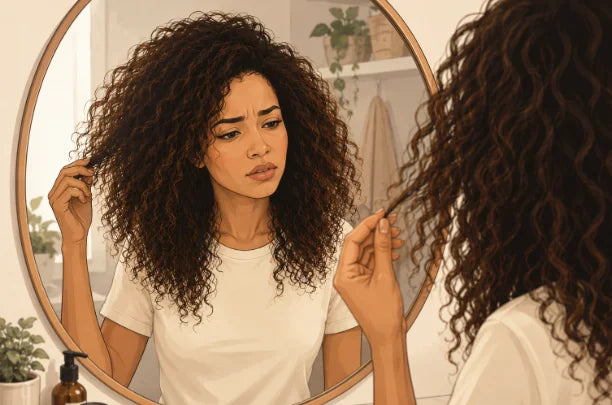

Do you wash your curly hair only to find it dry, dull, and hard to detangle once it's dry? The problem might not be your shampoo. It might be what comes next, or rather, what's missing afterward.
Conditioner is the most underestimated step in a curly hair routine. Yet, it's what closes the open cuticles after washing, rebuilds the hair fiber's protective film, and prepares your curls to be styled without breakage. Without it, even the best shampoo in the world will leave your hair fragile and unmanageable.
This guide explains how to choose, and especially how to use, the conditioner that truly meets the needs of your curls.

The spiral structure of curly hair is not just aesthetic; it has direct consequences for its health. At each curve of the curl, the cuticles (the scales that cover the hair fiber) struggle to lie flat, creating areas of fragility and dryness.
The scalp's natural sebum also has difficulty traveling down a spiral shaft, unlike straight hair.
As a result, curly hair is structurally drier, more porous, and more prone to breakage than straight hair. A classic conditioner, formulated for straight hair, is not enough. A richer formula is needed, one that targets both:
Not all conditioners meet the specific needs of curly hair. An adapted formula should facilitate detangling, preserve hydration, and help maintain the natural definition of curls without weighing them down.
It is also preferable to choose products designed for wavy, curly, or coily textures to achieve more visible results daily.
To complete this step, many people also use a leave-in treatment like the Leave-In Curly Hair Conditioner, which helps prolong hydration and preserve the suppleness of curls between washes.
The effectiveness of a conditioner also depends on how it's applied. Detangling with the right accessory helps distribute the product better throughout the hair while limiting breakage.
For curly hair, a brush specifically designed to respect the natural shape of curls, like the Denman Original D3 Brush, can facilitate styling on damp hair and improve curl definition after rinsing out the conditioner.
To care for your curls in the sun, chlorine, and sea water, consult our complete guide on summer curly hair routine.
The application technique is as important as the product itself. Here's the optimal method:
Step 1: Squeeze without rubbing After shampooing, gently squeeze your hair with your hands to remove excess water. Never rub with a terry towel, which lifts the cuticles and creates frizz.
Step 2: Apply to wet hair, strand by strand, divide your hair into 4 sections. On each still-damp section, apply a generous amount of conditioner from ends to mid-lengths. If necessary, re-wet hair with a spray bottle to facilitate product application.
Step 3: Detangle with fingers or a wide-tooth comb Always from ends to roots. The slip provided by the conditioner protects the hair fiber during this step and limits breakage.
Step 4: Leave on For optimal results, leave the conditioner on for 5 to 10 minutes under a conditioning cap. The heat slightly opens the cuticles and promotes the penetration of active ingredients.
Step 5: Rinse with lukewarm water Rinsing with cold or lukewarm water closes the cuticles, seals the active ingredients inside the hair fiber, and adds shine to curls.
If you're looking to optimize your routine, also discover the Abbey Yung method for curly hair


A conditioner alone is not enough to permanently transform your curls. Its effectiveness is multiplied when it is part of a coherent routine:
Gentle shampoo → Conditioner → Leave-in → Styling gel
Shampoo cleans the scalp without damaging the hair fiber. Conditioner facilitates detangling and helps preserve hydration. Leave-in provides additional hydration throughout the day, while styling gel sets curl definition and limits frizz.
For even more visible results regarding growth and density, it is recommended to use it with the entire Curly Hair Routine, which covers each step of the curly routine with complementary formulas.
Some habits to adopt in parallel:
Yes. By smoothing the cuticles and improving the hydration of the hair fiber, a conditioner suitable for curly hair helps limit frizz and improve curl definition.
Yes, it's even recommended for hair types 3 and 4 between two shampoos. Co-washing gently cleanses the lengths while maintaining hydration.
Yes, with lukewarm water. Poorly rinsed residue can weigh down the roots and reduce the volume of the curls. Leave-in conditioner, on the other hand, is applied without rinsing to damp hair after washing.
1 to 2 times a week depending on the condition of your hair. For very damaged hair or hair in transition, using it twice a week for the first few weeks will show visible results quickly.


